Experimental Nuclear and Particle Physics
Experimental Particle Physics (Accelerator)
Laboratory Website:
https://epx.phys.tohoku.ac.jp/eeweb/index_en.html
Academic Staff
- Professor/Atsuko K. Ichikawa
- Associate Professor/Kiseki Nakamura
- Assistant Professor/Yosuke Ashida
- Assistant Professor/Lukas Berns
About Research
The origin of elementary particle properties and the origin of matters in the universe are yet unknown in science. To resolve these mysteries, we are conducting researches using particle accelerators. We study properties of a heavy quark and Higgs particle in detail. We study how neutrinos changes their properties after produced by accelerators and traveling about 300 km. We are also trying to catch special properties of neutrinos by developing a new type of detectors.
Accelerator-based long-baseline neutrino oscillation experiment
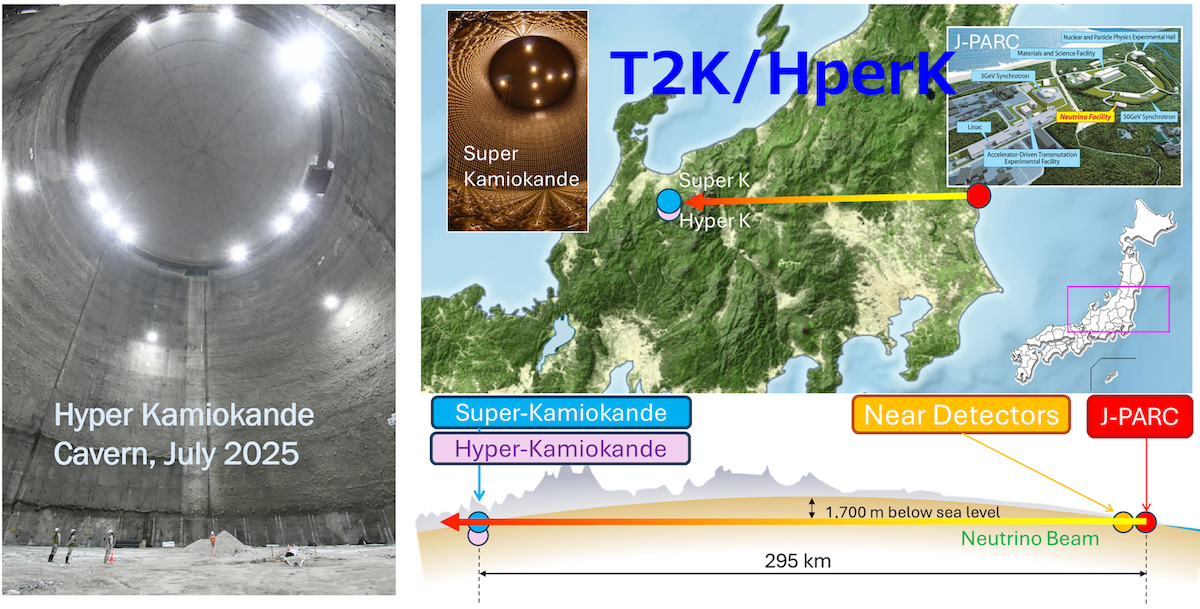
Our universe is made of only matter, and no antimatter has been found. This is a mystery that cannot be explained by modern science. By introducing a new piece, the “heavy neutrino”, to the Standard Model, it is possible to solve the puzzle of the extremely low mass of neutrinos and the matter and antimatter asymmetry in the universe. To test this hypothesis, it has been desired to discover “particle-antiparticle symmetry breaking (CP symmetry) in neutrinos” and to determine whether neutrino is so-called Majorana particle whose anti-particle is itself. Our group is conducting international collaboration experiments, the T2K experiment and the Hyper-Kamiokande project, to search for “CP violation in neutrinos”. The T2K experiment measures the neutrinos produced at the J-PARC accelerator with the Super-Kamiokande detector which locates 295 km away from J-PARC. The latest T2K result indicates that CP symmetry is broken at about 95% confidence level. To conclude if CP-symmetry is broken or not, it is necessary to increase amount of data and improve the measurement precision. We are developing equipment’s to increase the neutrino beam intensity, constructing neutrino detectors to improve the measurement precision and developing new analysis methods while continuing data acquisition. Super-Kamiokande detects neutrinos with 50 kton water. The Hyper-Kamiokande project will have a detector with 260 kton water and detect neutrinos with about 8 times higher efficiency. We aim to determine whether neutrinos break CP symmetry, and if so, the magnitude of the break, through the T2K experiment and the Hyper-Kamiokande experiment which will start in 2027.
Search for Neutrinoless double-beta decay
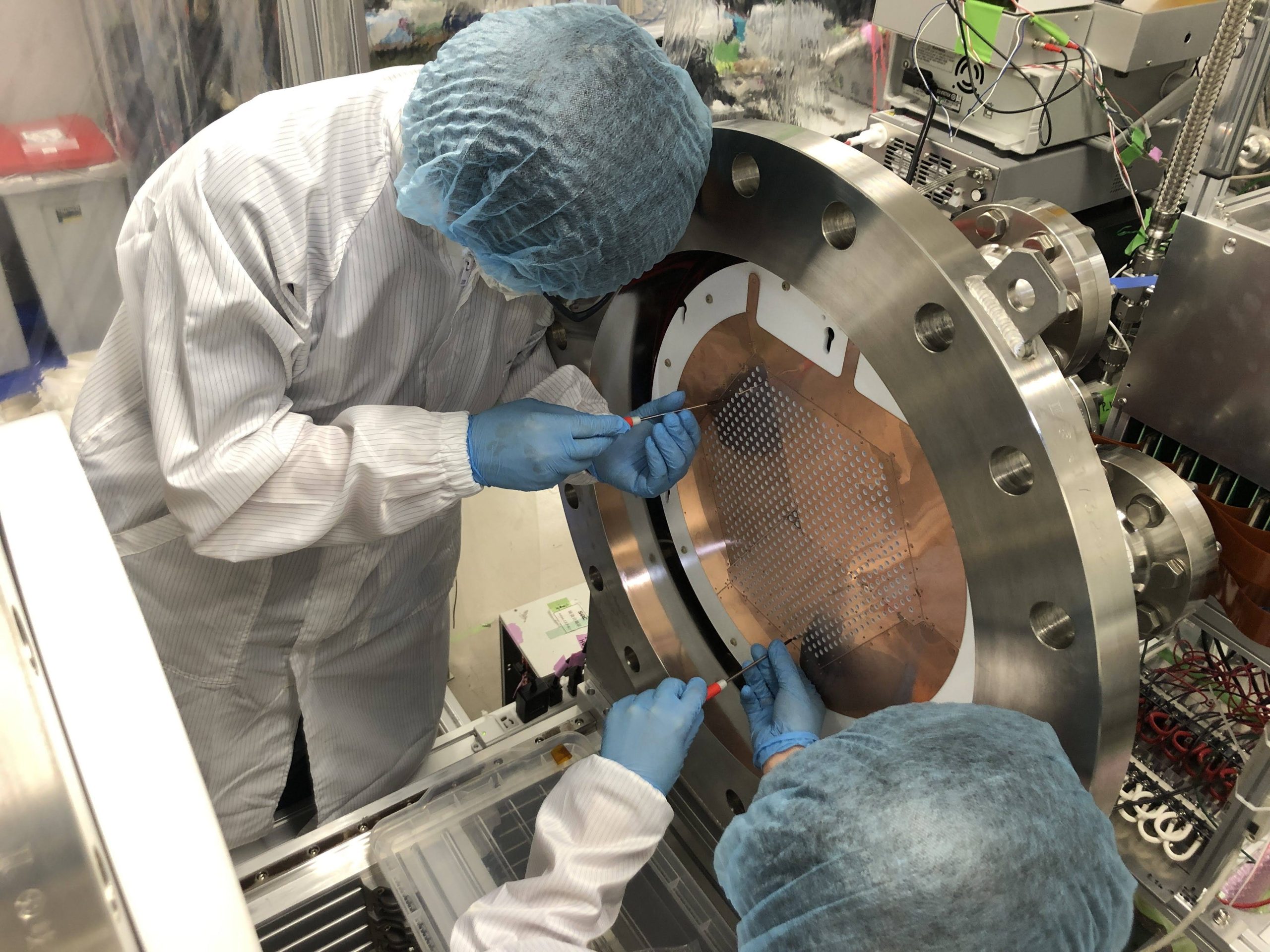
For the “heavy neutrino” scenario mentioned above to work, the neutrinos must be a “Majorana” particle. Many experiments in the world are searching for “neutrinoless double-beta decay”. Double-beta decay, in which two beta decays occur simultaneously, usually emits two antineutrinos. But if the neutrino is Majorana particles, it is possible, though very rare, for these two antineutrinos to annihilate each other, resulting in “neutrinoless double-beta decay”. Our AXEL experiment is also trying to search for “neutrinoless double-beta decay”. The AXEL detector uses 136-Xe, one of the double-beta decay nuclei, in a high-pressure gas state as a detector medium, too. We have developed a new principle that allows us to measure the energy with high resolution and to capture the emission of two beta rays.