Condensed Matter Experiment II
Physics of Living and Nonequilibrium Systems
Academic Staff
- Professor/Shoichi Toyabe
- Associate Professor/Yuka Sakuma
- Assistant Professor/Yohei Nakayama
- Project Assistant Professor/Kenji Nishizawa
About Research
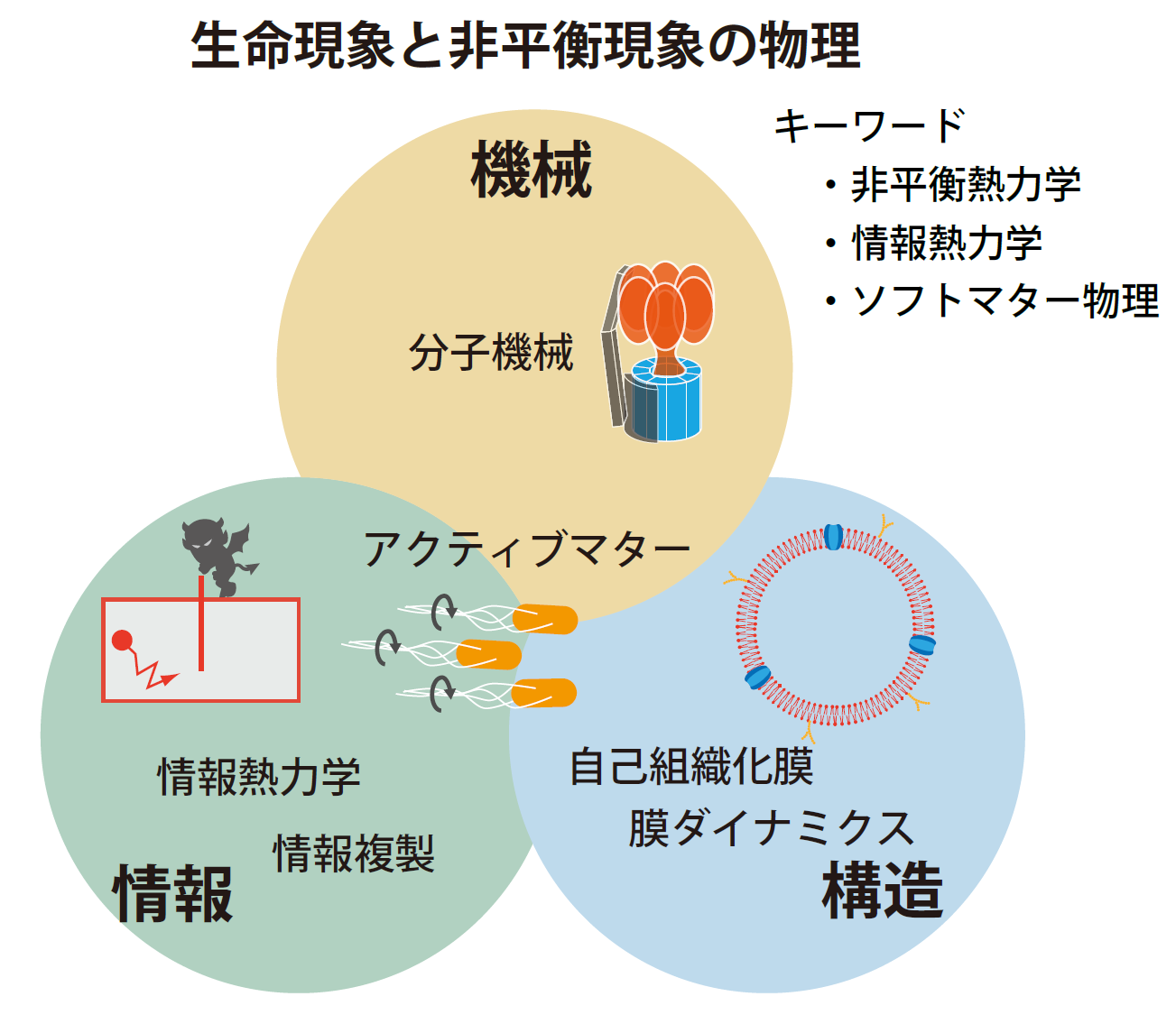
Our goal is to describe and understand the properties of nonequilibrium and soft systems, such as living systems, using physics. In particular, based on theories such as nonequilibrium thermodynamics, information thermodynamics, and soft matter physics, we are conducting experimental research on a wide range of systems from biological systems like biomolecules, cell membranes, and cell motility to physical systems involving microscopic particles.
We are currently conducting research on the following topics:
- Nonequilibrium Thermodynamics and Information Thermodynamics in Stochastic Systems
- Physics of Active Matter
- The Origin of Life / Genetic Engineering (Physics of Information Replication, Origin of Genetic Information, Membrane Replication, etc.)
- Physical Properties of Cell Membranes and Biological Functions
Within cells, nanomachines known as “biomolecular machines” operate autonomously and play crucial roles. We are investigating the physics underlying this motion, focusing on keywords such as nonequilibrium, fluctuations, and information, and utilizing single-molecule experimental techniques. In particular, we believe the concept of “information” is crucial for understanding biological phenomena, and we are conducting a wide range of research, from demonstrating the fundamental concepts of “information thermodynamics” to applying them to biological systems. Furthermore, we are integrating this knowledge to take on the challenge of creating artificial molecular machines that move autonomously.
Bacteria demonstrate advanced autonomous control, such as processing external information to regulate swimming and exhibiting “chemotaxis”, tha tis, moving toward nutrient sources. We aim to describe and understand the behavior of these microscopic autonomous systems based on physics. In particular, we are exploring the diverse and rich phenomena that emerge when bacteria swim in groups as the physics of “active matter.”
The so-called “origin of life”, the transition from non-living to living systems, contains rich content as a problem in physics. In particular, the origin of genetic information and self-replicating membranes are important subjects in non-equilibrium thermodynamics and soft matter physics. We investigate these topics as experimental physics through model experimental systems. Furthermore, by applying this knowledge, we aim to advance bioengineering technologies.
Cell membranes serve as the site for the expression of biological functions, and their mechanical properties, particularly membrane elasticity and fluidity, are crucial physical quantities that underpin these functions. By comparing the mechanical properties of living cell membranes in a nonequilibrium state with those of non-living cell membranes in an equilibrium state, we aim to identify the physical quantities characteristic of life and gain a deeper understanding of life from a physical perspective. Furthermore, we are applying these findings to identify differences in membrane physical properties between normal and diseased cells, and are exploring potential applications in medicine.
We are conducting this research in collaboration with research groups from diverse fields both in Japan and abroad, aiming to elucidate the physical laws that connect life and physics within a global research environment.